
People rarely announce that they are burning out. They work a little later, skip a break, cancel a day off, and say everything is fine. By the time it is said out loud, the person has often already decided to leave.
A team’s time records show some of this weeks earlier. This article explains what burnout is, the signs of overwork you can see in the hours, what to do when you see them, and where the data stops being useful.
What burnout is
The World Health Organization includes burn-out in its International Classification of Diseases as an occupational phenomenon. It is not classified as a medical condition. The WHO describes it as a syndrome resulting from chronic workplace stress that has not been successfully managed, with three dimensions:
- feelings of energy depletion or exhaustion;
- increased mental distance from one’s job, or feelings of negativism or cynicism related to it;
- reduced professional efficacy.
Two things follow from that definition. Burnout comes from the work, not from a weakness in the person. And tiredness is only the first of the three: the distance and the drop in confidence are harder to see and matter as much.
Why the hours matter
Long hours are not the only cause of burnout, but they are the one you can measure, and they carry risks of their own. A joint study by the WHO and the International Labour Organization, published in 2021, estimated that working 55 or more hours a week is associated with a 35% higher risk of a stroke and a 17% higher risk of dying from ischemic heart disease, compared with working 35 to 40 hours.
Those are averages across populations and say nothing about any one person. They are a good reason to treat a run of very long weeks as something to look into, not as dedication to be admired.
Seven signs in a team’s time records
| What you see | Where it shows | What it may mean |
|---|---|---|
| Long weeks, three or more in a row | Weekly totals by person | The workload does not fit the week |
| Work at weekends and late in the evening | Start and end times | The day is too full to finish in |
| No leave taken for months | Time off records | The person does not feel able to be away |
| Breaks getting shorter or disappearing | Break entries | Working through lunch to keep up |
| Many projects in one day | Entries per day | Constant switching, which is tiring in itself |
| Overtime that always falls on the same person | Overtime by person | One person is covering for a gap in the team |
| Hours that suddenly drop, or timesheets that arrive late | Weekly totals; submission dates | Withdrawal, which is the second WHO dimension |
The last one is the easiest to miss, because it looks like the problem going away. Someone who was working fifty hours and is now logging thirty-five with gaps has not necessarily recovered.
One week of any of these is noise. A deadline, a sick colleague or a launch explains it. The signal is a pattern that lasts three or four weeks and belongs to the same person.
Overwork, or just a busy month?
Every team has heavy weeks, and most of them are harmless. Four questions separate a busy spell from a problem.
| Question | A busy spell | A problem |
|---|---|---|
| How long has it lasted? | A week or two, with an end date | A month or more, with no end in sight |
| Is there recovery afterwards? | A quieter week follows | The next deadline starts at once |
| Why is it happening? | A launch, a deadline, cover for someone on leave | The normal workload, every week |
| Did the person have a say? | They agreed to it and know why | It was simply expected |
If the answers sit in the right-hand column, more effort from the person will not solve it. The plan is wrong, and the plan is the manager’s to change.
Signs that never appear in the data
Time records see hours. They do not see how those hours felt. Watch as well for the things only a person can notice:
- Someone who used to speak up in meetings goes quiet.
- Small mistakes in work that used to be careful.
- Cynical remarks about clients or the company from someone who was not cynical before.
- A flat answer to “how is it going?” that never changes.
These map to the WHO’s second and third dimensions, and they often arrive before the hours change at all.
What to do when you see the signs
- Check that the pattern is real. Look at four weeks, not one, and rule out the obvious: a deadline, a holiday, a mistake in the records.
- Talk privately, and soon. Start with the workload, not with the person: “You have had three long weeks. What is driving that?”
- Listen for the cause. Too much work, unclear priorities, a difficult client and covering for a vacancy all need different fixes.
- Take work away. Time off without a lighter load means the same pile is waiting on Monday. Move a project, push a deadline or bring in help.
- Agree what will change, and by when. Then look at the hours again in two weeks.
- Fix the system, not only the case. If one person was overloaded, check who is next in line for the same thing.
This article is about workload and management. It is not medical advice. Someone who is struggling with their health should talk to a doctor, and a manager’s job is to make that easy, not to diagnose.
What not to do
- Do not use the data to rank people. The moment long hours are praised or short hours questioned, the records stop being honest.
- Do not add monitoring. Watching an overloaded person more closely adds to the load.
- Do not raise it in front of the team.
- Do not offer a wellness app in place of fewer tasks. The WHO’s definition puts the cause in the work.
- Do not wait for the annual review.
Preventing it across the team
- Plan against real capacity. A person with a week of leave and two public holidays does not have a normal month.
- Make overtime visible to someone. Hours nobody looks at can grow for a long time.
- Make leave normal. Managers who take their own are the strongest signal.
- Spread the awkward work. The on-call week, the difficult client and the late release should rotate.
- Tell the team what you look at. “I check weekly totals so I can spot overload” lands very differently when it is said first and not discovered later.
If the long hours are your own
The same records work for the person doing the hours. If you suspect you are heading for trouble, look at your own last eight weeks before you talk to anyone.
- Count the weeks that ran well past your normal hours, and the weekends you worked.
- Find your last full week off, and the last day you took a proper lunch.
- Note which project or client the extra time went to.
Then take those three facts to your manager. “I have worked six long weeks out of eight, mostly on one account” starts a conversation about workload. “I am tired” starts one about you, which is harder to have and easier to wave away.
How Punchly shows the hours
Punchly is time tracking software, so here is plainly what it can show you, and on which plan.
| What to look at | In Punchly | Plan |
|---|---|---|
| Hours per day for each person | The Weekly report, grouped by person | Free |
| Start, end, breaks and overtime | The attendance report. Each column can be filtered, for example overtime above a number you set | Standard |
| Someone tracking more than they should | A reminder can go to a person and their manager when they track more than their capacity | Standard |
| Leave taken and leave left | Time off balances for each person | Standard |
| Load against capacity, ahead of time | Scheduling: capacity allows for days off, holidays and approved leave | Pro |
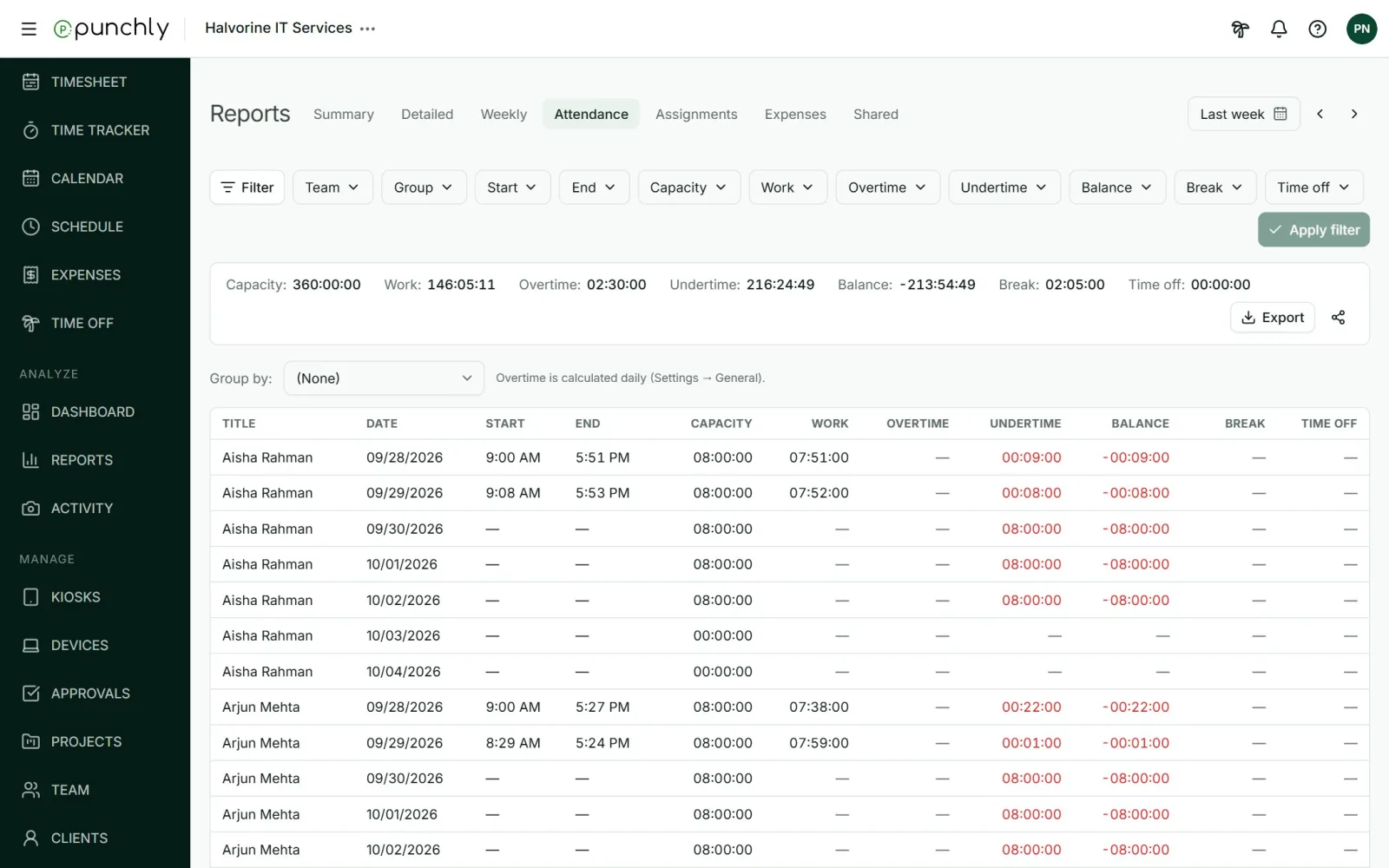
Punchly does not score wellbeing and cannot tell you that someone is burning out. It shows the hours. Deciding what they mean takes a conversation.
Questions people ask
Punchly is free for teams of up to 5. Every new workspace gets 7 days of the Pro features, with no credit card.